
Category Archives: Conferences

Invited Speaker at BX2025

I had the opportunity to speak at the 2025 Behavioral Exchange Conference hosted by the Behavioral Insights Team (BIT) and the Behavioral Science Group at NYU Abu Dhabi. This year, the conference focused on New Frontiers in Behavioral Science, bringing to life the latest developments in the field and hearing from the people behind them.

In my talk, I explored how AI can allow us to solve the current problem of the lack of generalizability and specificity in behavioral science. I also participated in a panel on the power of social connections and community with Michael Bailey from Meta and Wardah Malik from BEworks.

My deepest thanks to the Behavioural Insights Team and the the Behavioral Science Group for hosting the event and inviting me!

Inaugural Cohesive Capitalism Summit at the London School of Economics

I attended the Inaugural Cohesive Capitalism Summit at the London School of Economics. This summit was the public launch of the new LSE Programme on Cohesive Capitalism, a major multi-disciplinary initiative to investigate new politico-economic paradigms, institutions and policies that could serve the common interest.

My thanks to the London School of Economics for hosting the event!

Invited speaker at workshop on “An Aspirational Approach to Planetary Futures”

In April, I was invited to speak at a workshop on “An Aspirational Approach to Planetary Futures” by the United Nations Development Programme’s Human Development Report Office at the University of Oxford.

I presented work from my book A Theory of Everyone, and from the papers below:

  • Muthukrishna, M. (2019). Cultural Evolutionary Public Policy. Nature Human Behaviour, 4, 12-13. [Download] [Publisher]
  • Schimmelpfennig, R. & Muthukrishna, M.  (2023). Cultural Evolutionary Behavioural Science in Public Policy. Behavioural Public Policy. [Awarded EUSPR Presidential Award 2023] [Publisher] [Download] [Twitter] [LinkedIn]
  • Henrich, J. & Muthukrishna, M. (2021). The Origins and Psychology of Human Cooperation. Annual Review of Psychology, 72, 207-40. [Download] [Publisher] [Twitter]
  • Muthukrishna, M., Francois, P., Pourahmadi, S., & Henrich, J. (2017). Corrupting Cooperation and How Anti-Corruption Strategies May Backfire. Nature Human Behaviour, 1(0138). [Download] [Summary Post] [Publisher]

My deepest thanks to the University of Oxford for having me!


Invited speaker at Creativity: Innovation, Transmission and Motivation in Animals, Humans and Societies Meeting, Pontifical University of the Holy Cross, Rome, Vatican

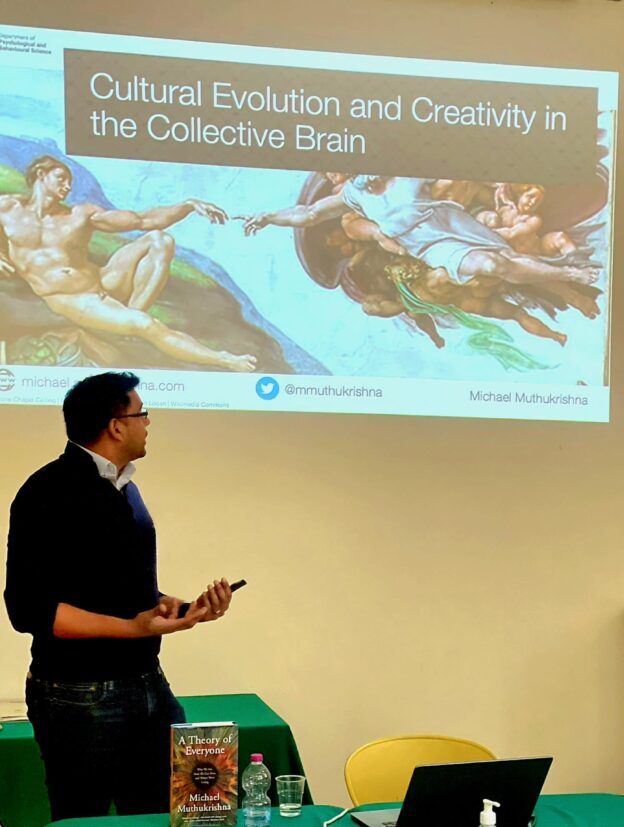
I was delighted to be an invited speaker at the meeting on “Creativity: innovation, transmission, and motivation in animals, humans, and societies,” which took place at the Pontifical University of the Holy Cross in Rome. The meeting is part of an effort to strengthen the relationship between the Vatican and science.

I presented my research on “Cultural Evolution and Creativity in the Collective Brain”, including new work, my book, A Theory of Everyone, and previous work in these papers:

This event brought together an interdisciplinary array of scholars, priests, and researchers, and I am looking forward to continuing this important dialogue.

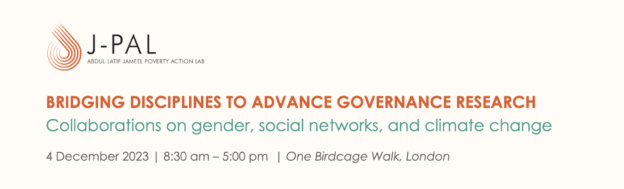
Panelist and Invited Speaker on Bridging Disciplines to Advance Governance Research at the Governance Initiative, Abdul Latif Jameel Poverty Action Lab, London

I recently participated as a panelist and invited speaker at the Governance Initiative organized by the Abdul Latif Jameel Poverty Action Lab in London, UK, at their conference on “Bridging Disciplines to Advance Governance Research: Collaborations on Gender, Social Networks, and Climate Change.”

I was a panelist on the “Perspectives on The Challenges and Importance of Multidisciplinary Collaboration in Governance Research,” alongside Nava Ashraf and Noam Yuchtman. This engagement provided a forum to discuss innovative strategies for governance and poverty alleviation, leveraging insights from cultural evolution and economic psychology to inform policy and action.

I tackle more of this in my book, “A Theory of Everyone,” and other relevant papers on the topic can be found here:

  • Schimmelpfennig, R. & Muthukrishna, M.  (2023). Cultural Evolutionary Behavioural Science in Public Policy. Behavioural Public Policy. [Awarded EUSPR Presidential Award 2023] [Publisher] [Download] [Twitter] [LinkedIn]
  • Muthukrishna, M., Bell, A. V., Henrich, J., Curtin, C., Gedranovich, A., McInerney, J. & Thue, B. (2020). Beyond Western, Educated, Industrial, Rich, and Democratic (WEIRD) Psychology: Measuring and Mapping Scales of Cultural and Psychological Distance. Psychological Science, 31(6), 678-701. [Download] [Supplementary] [Code] [Summary Post] [Publisher] [Twitter]

My thanks to the Abdul Latif Jameel Poverty Action Lab for organizing the event, and my co-panelists, Nava Ashraf and Noam Yuchtman for an engaging session.

The Evolution of Comity: Ultimate Constraints on the Scale of Cooperation at the School of Collective Intelligence, Mohammed VI Polytechnic University

I gave an invited talk at the School of Collective Intelligence at Mohammed VI Polytechnic University in Morocco on the dynamics of collective intelligence within communities and its significance in driving innovation and addressing complex problems.

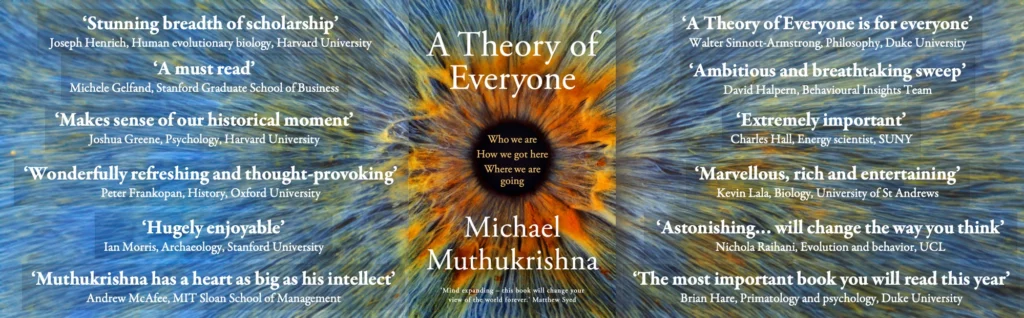
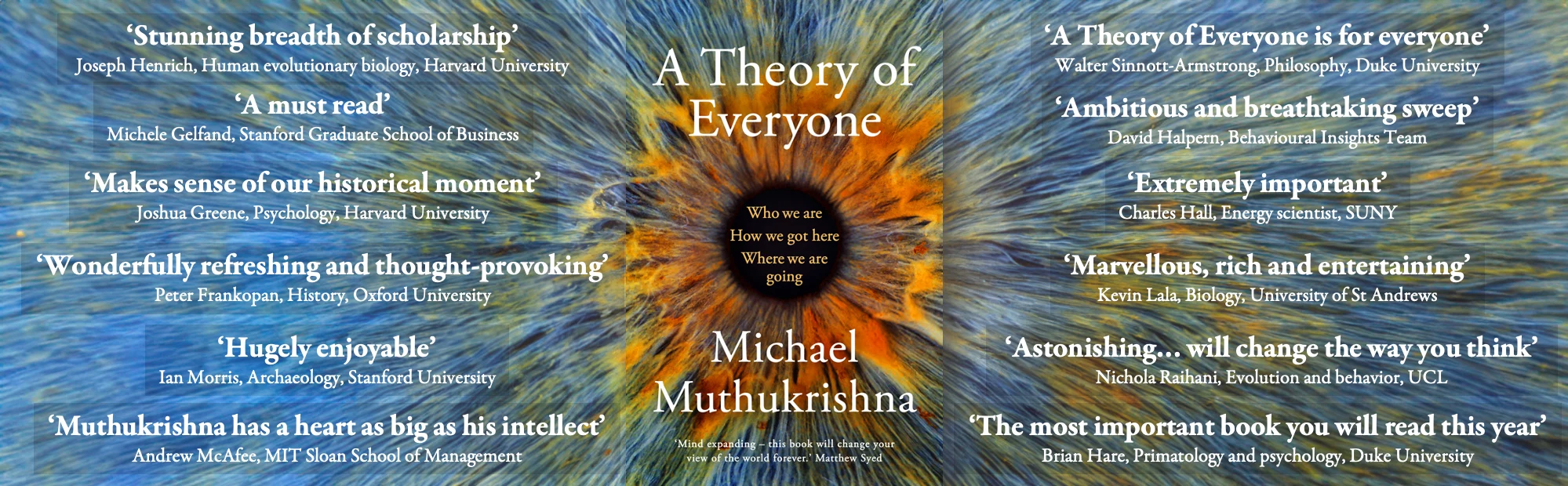
  • Muthukrishna, M. (2023). [BOOK] A Theory of Everyone: Who we are, how we got here, and where we’re going. MIT Press (US & Canada) / Basic Books (UK and Commonwealth) [Amazon and Local Bookstores]
  • Schnell, E., Schimmelpfennig, R., & Muthukrishna, M. (2023). The Size of the Stag Determines the Level of Cooperation. bioRxiv
  • Muthukrishna, M., Henrich, J. & Slingerland, E. (2021). Psychology as a Historical Science. Annual Review of Psychology, 72, 717-49. [Download] [Publisher] [Twitter]
  • Henrich, J. & Muthukrishna, M. (2021). The Origins and Psychology of Human Cooperation. Annual Review of Psychology, 72, 207-40. [Download] [Publisher] [Twitter]

The title of my talk was “The Evolution of Comity: Ultimate Constraints on the Scale of Cooperation.” Key publications relevant to this discussion are:

The research is related to my book, and a grant focused on expanding our comprehension of the foundational processes facilitating cooperation, with the goal of enhancing social harmony and unity. I am grateful to the faculty, students and staff at Mohammed VI Polytechnic University for the invitation and their hospitality.

Are Collectivist Cultures More Prone to Rapid Transformation? at the Collectivism, Social Change and Collective Problems Symposium, Society for Personality and Social Psychology (SPSP) Annual Convention 2022

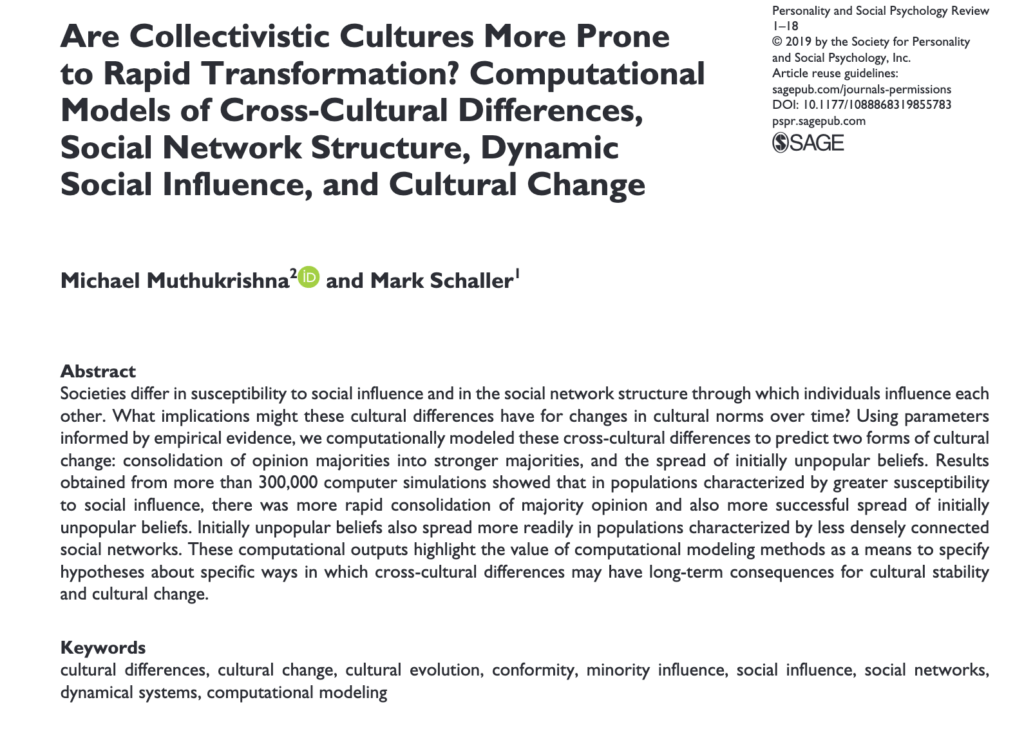
I presented my paper on “Are Collectivist Cultures More Prone to Rapid Transformation?” at the Society for Personality and Social Psychology (SPSP) Annual Convention 2022, San Francisco, CA. It was part of a symposium on “Collectivism, Social Change, and Collective Problems” organized by Suyi Leong and Heejung Kim.

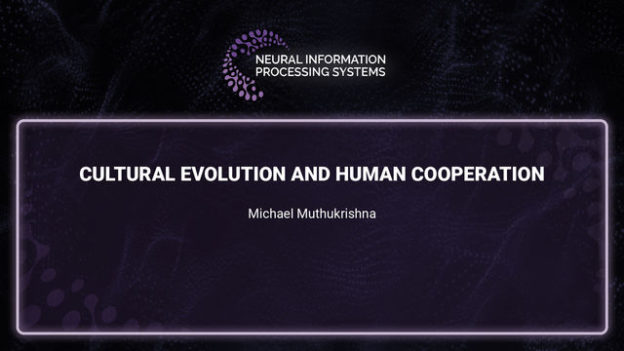
Cultural Evolution and Human Cooperation: Keynote speaker at Cooperative AI Workshop, NeurIPS 2021

I was a keynote speaker at the Cooperative AI workshop at the 2021 Conference on Neural Information Processing Systems (NeurIPS). I spoke about “Cultural Evolution and Human Cooperation” and its relevance for understanding problems in cooperative AI. Some of the topics covered included, an introduction to dual inheritance theory and cultural evolution, how and why humans cooperate, and why human cooperation varies in scale, intensity, and domain across societies.

My speech and slides are available here.

The ties that bind us at Beveridge 2.0. Symposium: Reciprocity across the life-cycle [online]

I gave a talk on “The ties that bind us” at the Beveridge 2.0. Symposium: Reciprocity across the life-cycle hosted by STICERD and the LSE School of Public Policy The talk applied the science of cooperation to the problem of the future welfare state, particularly around pensions and retirement. A corresponding paper is under review at LSE Public Policy Review.

Cooperation and the moral circle: When cooperation harms the collective good at SPSP 2021 Justice and Morality Pre-Conference [online]

I gave a talk on “Cooperation and the moral circle: When cooperation harms the collective good” as part of the SPSP 2021 Justice and Morality Pre-Conference. It’s part of some new work on the problem of the expanding moral circle as it links to cooperation, corruption, prosocial, and antisocial behavior. A related working paper is available here: https://www.biorxiv.org/content/10.1101/2021.02.19.432029v2

Behavioral Science for Global Good at Behavioral Insights Group (BIG) conference hosted by Harvard Business School / Harvard Kennedy School, Harvard University, Cambridge, MA

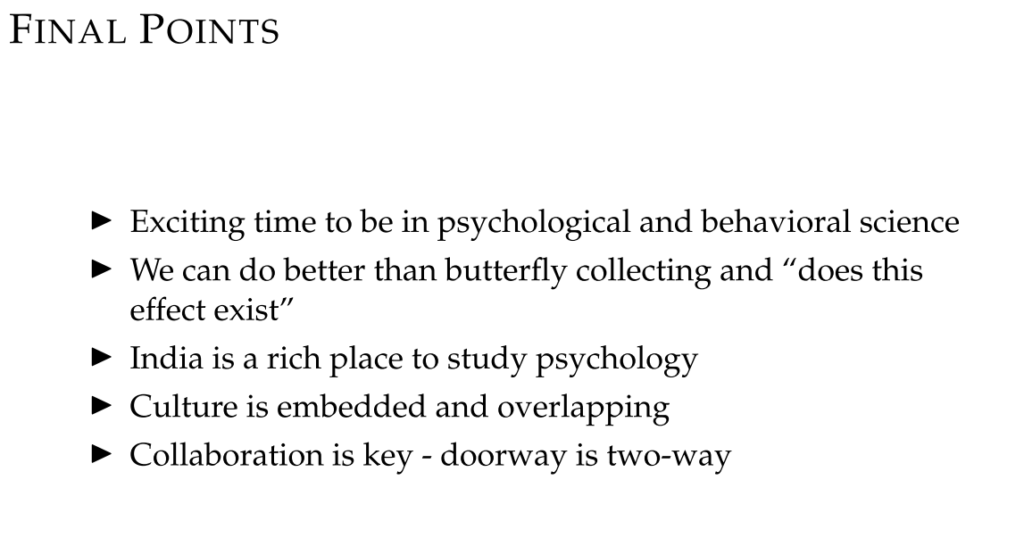
I was a panelist at the  Behavioral Science for Global Good at Behavioral Insights Group  (BIG) conference hosted by Harvard Business School (add link) / Harvard Kennedy School (add link). The goal of the panel was to offer insight into the ways in which behavioral science may need to change in the future in order to fulfill its stated mission to make a positive difference in the world—particularly on how to expand our focus beyond predominantly WEIRD researchers, WEIRD research topics, and WEIRD populations.

My fellow panelists included:

  • Dolly Chugh, Associate Professor of Management and Organizations at NYU
  • Chaning Jang, CSO / VP of Research at the Busara Center for Behavioral Economics
  • Shinobu Kitayama, Robert B. Zajonc Collegiate Professor of Psychology at University of Michigan
  • Steven Roberts, Assistant Professor of Psychology at Stanford University
  • Neela Saldanha, Senior Advisor at the Busara Center for Behavioral Economics – who did a wonderful job chairing the discussion.

Diverse Intelligences grantee meeting hosted by the Templeton World Charity Foundation at the University of St Andrews, Scotland, UK

I spent the last few days at the Templeton World Charity Foundation (TWCF) Grantee Meeting, online instead of the University of St Andrews, Scotland (due to the pandemic). This conference has become an annual highlight for me, I thoroughly enjoy discussing intelligence with an amazingly diverse and interdisciplinary group of brilliant scholars.

“What affects our level of intelligence?” at the Diverse Intelligences Summer Institute hosted by the Templeton World Charity Foundation at the University of St Andrews, Scotland, UK.

This year’s Diverse Intelligences Summer Institute was held online due to the pandemic. I delivered a lecture over Zoom on “What affects our level of intelligence?” followed by a lively discussion with the students. The lecture discussed brain evolution, the Cultural Brain Hypothesis, collective brain, and a cultural evolutionary account of intelligence. You can watch it below:

Communication and Competition at the Learning Innovations LaBarge tree “LILA” at the Harvard Graduate School of Education, Cambridge, MA

 I ran a workshop on communication competition at the Learning Innovations Laboratory (LILA), part of Project Zero at the Harvard Graduate School of Education. The LILA group include people from industry and the military. We discussed various aspects of the science of cooperation, including how and when it fails.I also introduced some new work on the paradox of diversity and on measuring cultural distance.

One of the participants, Sue Borchardt is now making an animated series based on the talk.